
If you are looking for a place in northern Vietnam where you can escape the crowds, breathe fresh mountain air and walk through a landscape that still feels genuinely wild, Ba Quáng Grass Hills is well worth putting on your Cao Bằng itinerary.
Also known locally as Vĩnh Quý Grass Hills, Ba Quáng lies in Vĩnh Quý Commune, Hạ Lang District, around 70–80 km from Cao Bằng City. It is still relatively quiet compared with better-known attractions such as Bản Giốc Waterfall, Nguom Ngao Cave and the famous mountain passes of Cao Bằng.
What makes Ba Quáng special is not a spectacular monument or a single viewpoint. It is the feeling of space.
Here, rolling grass-covered hills stretch between layers of mountains, small villages sit quietly in the valleys, and the landscape changes colour with the seasons. There are no large resorts, souvenir shops or crowds of tour buses. Instead, you get wind, grass, mountains and the occasional sound of a motorbike travelling along a distant village road.
For travellers who enjoy nature, photography, gentle hiking and less-developed destinations, this is one of the places in Cao Bằng I would recommend exploring.
A Landscape That Changes With the Seasons
The first thing you notice when you arrive at Ba Quáng is how open the landscape feels.
The hills are broad and gently rounded, covered mainly by grass rather than dense forest. From the higher points, you can look across valleys, rice fields, scattered houses and successive layers of mountains.
It is a very different experience from standing beneath a waterfall or inside a cave. There is nothing dramatic happening in front of you—and that is precisely the attraction.
The landscape changes considerably throughout the year.
The Green Season: May to October
From around May to October, the hills become intensely green. Fresh grass covers the slopes, and the wind creates gentle waves across the landscape.
After rain, the colours become particularly vivid: green hills, dark mountain forests, silver-grey clouds and small patches of farmland in the valleys.
This is also one of the better periods for cloud watching, especially after a rainy night when moisture collects around the surrounding mountains. Local conditions vary from day to day, so seeing a sea of clouds is never guaranteed—but when it happens, the experience can be spectacular.
If you enjoy photography, I recommend arriving before sunrise rather than coming in the middle of the day.
The early morning light is softer, the air is cooler and mist often hangs over the valleys. As the sun rises, the clouds and mountains gradually reveal themselves, creating a completely different landscape every few minutes.
The Golden Season: October to January
If green is the colour of Ba Quáng’s summer, gold is the colour of its winter.
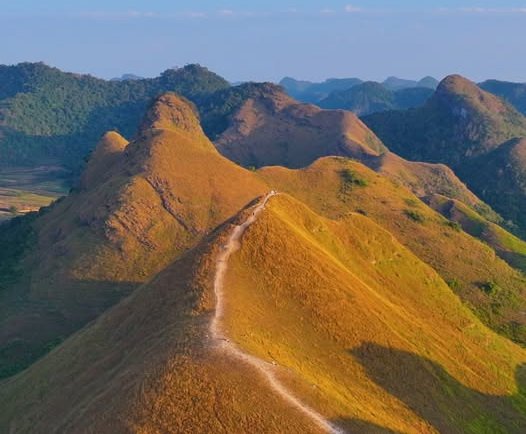
From around October, the grass gradually changes from green to yellow, orange and brown as the dry season arrives. The exact timing and intensity vary with the weather, but the hills can become beautifully golden during the cooler months.
This is when you may hear the area described as Ba Quáng Burnt Grass Hill or Vĩnh Quý Burnt Grass Hill.
Don’t expect an actual field that has been deliberately burned. The name refers to the dry, golden-brown appearance of the grass.
On a sunny afternoon, the effect can be remarkable. The hills glow under the low sunlight, while the surrounding mountains remain darker in the background.
For me, this is one of the most beautiful times to photograph Ba Quáng.
There is something almost cinematic about standing on the hillside with golden grass moving in the wind, especially in the late afternoon when the light becomes warm and directional.
Some travellers have even compared the scenery to a miniature Mongolia because of its open grassland, rolling terrain and feeling of wilderness.
The comparison is obviously poetic rather than geographical—but once you stand there, you understand why people make it.
A Short Hike With a Big View
One of the nice things about Ba Quáng is that you don’t need to be an experienced trekker to enjoy it.
Depending on where you park, the final walk to the higher part of the hill is relatively short. Local travel sources describe the final approach as roughly 700 metres, while other descriptions put the uphill walk at around 15–20 minutes.
The distance itself is not the difficult part.
The trail can become slippery after rain, and some sections are steep enough to make you work for the view. Good walking shoes are therefore much more useful than fashionable sneakers.
Take your time.
As you climb, stop occasionally and turn around. The view behind you often becomes more interesting with every few metres of elevation.
From the higher ground, you can see a mixture of grass-covered hills, farmland, small villages and distant mountain ranges.
This is also where you begin to appreciate the geography of this part of Cao Bằng. The mountains are not isolated peaks; they form layer after layer, creating a landscape that seems to continue far beyond the horizon.
Go Early If You Want the Best Light
There are two times of day I particularly recommend at Ba Quáng: early morning and late afternoon.
Sunrise
If the weather cooperates, sunrise offers the possibility of mist and low cloud sitting in the valleys below.
The best conditions often come after rain, when moisture remains in the air overnight. But mountain weather is unpredictable, so cloud hunting should be treated as an experience rather than a guarantee.
Sometimes you get the famous sea of clouds.
Sometimes you get fog.
And sometimes you get absolutely nothing except a clear blue sky.
That unpredictability is part of the fun.
Late Afternoon
If you are not interested in waking up before dawn, come in the late afternoon.
The low sunlight gives the grass a warm colour and creates beautiful shadows along the curves of the hills.
During the golden season, this can be particularly impressive.
I would rather spend one quiet hour here around sunset than rush through the area in the middle of the day just to take a few photographs.
Getting to Ba Quáng Grass Hills
This is one of the most important things to understand before visiting.
Ba Quáng is not a convenient roadside attraction.
From Cao Bằng City, the journey takes you deeper into the countryside and through mountainous terrain. The final approach includes smaller roads, and some sections can be challenging, particularly after rain. Local sources recommend experienced riders or vehicles suitable for rougher mountain roads.
For visitors who are unfamiliar with northern Vietnam, I would not recommend simply renting a motorbike in Hanoi and attempting the journey without previous mountain-riding experience.
The roads in this region can be narrow and winding, with steep sections and rapidly changing weather.
A private car with an experienced local driver is a much more comfortable option for many travellers.
If you are travelling by motorbike, make sure you are confident riding on mountain roads and check the weather forecast before setting out.
And remember: in northern Vietnam, the journey is part of the experience.
You will pass through quiet mountain communities, farmland and valleys where everyday life continues at a much slower pace than in Hanoi.
What Is There to Do at Ba Quáng?
Don’t come here expecting a long list of organised activities.
That is not what Ba Quáng is about.
The main attractions are walking, photography, watching the clouds, enjoying the scenery and simply slowing down.
You can:
- Walk across the grass-covered hills
- Photograph the changing colours of the landscape
- Watch sunrise or sunset
- Go cloud hunting after rainy weather
- Explore the surrounding countryside
- Camp overnight when local facilities and weather conditions allow
- Combine Ba Quáng with other attractions in the Cao Bằng region
Some basic visitor facilities have developed around the area, including simple places to rest, eat and have drinks, while some local operators offer tents for overnight stays. Because tourism infrastructure remains limited, facilities and availability can change, so I recommend checking locally before relying on camping services.
Is Ba Quáng Worth Visiting?
If you are visiting Cao Bằng for the first time and only have one day, I would prioritise the region’s major attractions.
But if you have two or more days, Ba Quáng becomes much more interesting.
It works particularly well as part of a wider Cao Bằng journey that includes Bản Giốc Waterfall, Nguom Ngao Cave, traditional villages and the mountain roads around Hạ Lang.
Several current Cao Bằng itineraries already combine Vĩnh Quý Grass Hills with Bản Giốc and other regional attractions, which makes sense geographically and allows travellers to experience a very different side of the province.
The waterfall gives you drama.
The cave gives you geology.
The villages give you culture.
And Ba Quáng gives you space.
That combination is what makes a Cao Bằng journey memorable.
A Few Practical Tips Before You Go
Wear proper walking shoes.
The final trail is short, but slopes can be slippery, particularly after rain.
Bring water.
Don’t expect convenience stores or tourist facilities every few minutes.
Check the weather.
Mountain weather can change quickly, and rain can make the approach more difficult.
Bring a light jacket in the cooler months.
The hills can feel considerably colder and windier than Cao Bằng City.
Don’t rush.
Ba Quáng is not a place to spend ten minutes taking photographs before getting back in the car.
Give yourself time to walk, sit down and watch the landscape.
Respect the local environment.
Take your rubbish with you, avoid damaging the grass and ask before camping or lighting fires.
Most importantly, remember that this is still a relatively undeveloped destination. That is exactly why it is beautiful.
Ba Quáng: The Beauty of Going Somewhere Quiet
Cao Bằng is famous for its waterfalls, caves, rivers and dramatic mountains.
But some of my favourite places are the quieter ones—the places where there is no ticket queue, no souvenir shop and no loudspeaker telling you where to stand for a photograph.
Ba Quáng is one of those places.
Stand on the hillside and look across the grasslands. Watch the wind move through the grass. Look down at the small villages in the valleys and the mountains fading into the distance.
There is no major monument here.
There doesn’t need to be.
Ba Quáng’s attraction is the landscape itself—and the rare feeling of having enough space to simply stop and enjoy it.
If you are travelling through northern Vietnam and want to experience a quieter, more authentic side of Cao Bằng, Ba Quáng Grass Hills deserves a place on your route.