
About 35 kilometers south of Hanoi, beyond the busy streets and high-rise buildings of the capital, lies Quang Phu Cau Incense Village — a traditional craft village where the air carries the gentle fragrance of herbs and the countryside can suddenly turn bright red under the sun.
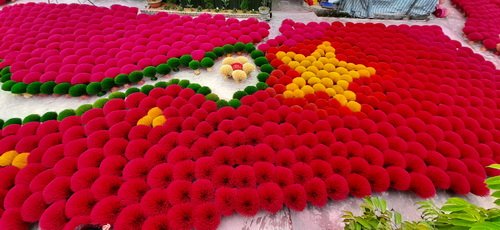
For many international visitors, Quang Phu Cau is first discovered through photographs: thousands of incense sticks arranged in enormous colorful bundles, spreading across courtyards and village lanes like flowers blooming on the ground.
But there is much more to Quang Phu Cau than its famous photographs.
This is a living Vietnamese craft village, where incense production remains part of everyday life. Families still prepare bamboo sticks, dye them, make incense paste, dry the finished products and pack them for customers. Modern machinery has made some stages of production faster, but the knowledge and traditions behind the craft remain deeply connected to the local community.
If you want to experience a different side of Hanoi — one that is quieter, more rural and closely connected to traditional Vietnamese life — Quang Phu Cau is well worth the journey.
Where Is Quang Phu Cau Incense Village?
Quang Phu Cau is located in Ung Hoa District, in the southern part of Hanoi, approximately 35 kilometers from the city center. The journey from central Hanoi usually takes around one to one and a half hours, depending on traffic.
The village is not a museum or a purpose-built tourist attraction. It is a working craft community spread across several local hamlets.
That is part of its charm.
As you leave Hanoi behind, the landscape gradually changes. The traffic becomes lighter, houses become lower, and the urban landscape gives way to the villages and countryside of southern Hanoi.
Then, almost unexpectedly, you begin to see the colors.
Red bundles of bamboo sticks appear outside homes. Workers move between small workshops. Incense sticks are laid out to dry wherever there is enough space to catch the sunlight.
It is a very different picture of Hanoi from the one most visitors experience in the Old Quarter.
A Craft with More Than a Century of History
The incense-making tradition in Quang Phu Cau has existed for more than 100 years.
According to local and tourism authorities, the craft first developed in Phu Luong Thuong Village before gradually spreading to other communities in the area, including Dao Tu, Cau Bau and Xa Cau. What began as a small rural craft eventually became an important source of livelihood for thousands of local families.
In the early days, incense production was largely done by hand and was often a secondary occupation.
Over time, however, the craft grew into a major local industry.
Today, Quang Phu Cau is known not only in Hanoi but also beyond Vietnam. Local incense products are made for domestic use and are also sold to overseas markets. At the same time, the village has begun welcoming increasing numbers of visitors who want to see the traditional craft for themselves.
What makes the story particularly interesting is that the village has managed to adapt to modern production without completely losing its traditional identity.
How Is Incense Made in Quang Phu Cau?
One of the best reasons to visit Quang Phu Cau is to see that the famous red incense bundles are not simply decorations.
They are the result of a surprisingly detailed production process.
The work begins with bamboo or similar materials used to make the incense sticks. The bamboo is cut, split and shaped before the sticks are sorted and prepared.
The lower part of the sticks is then dyed — traditionally producing the distinctive red or pink color that has become so strongly associated with Quang Phu Cau.
Other workers prepare the fragrant mixture used to form the incense itself. Depending on the product, different aromatic ingredients may be combined to create the desired fragrance.
Finally, the incense is arranged and left to dry.
In the past, much of this work was carried out entirely by hand. Today, machinery is used for some stages to increase productivity, but careful selection of materials and the experience of local craftsmen remain important parts of the process.
Walking through the village, you can often see different stages of production happening at the same time.
One person may be splitting bamboo while another dyes the sticks. Somewhere else, workers may be sorting, bundling or preparing the finished incense.
That is what makes the visit interesting: you are seeing a real production village at work.
Why Is Quang Phu Cau Famous for Its Red Incense?
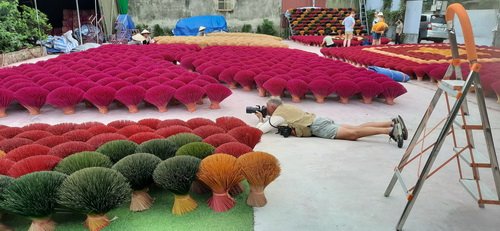
The image that has made Quang Phu Cau famous around the world is the sight of thousands of incense sticks arranged in large circular or fan-shaped bundles.
When the sun is shining, the red and pink sticks create an extraordinary visual effect.
From above, the bundles can look like giant flowers blooming across the village.
From ground level, the effect is equally impressive. The red sticks contrast with the green countryside, old village houses and workers moving around the drying areas.
This is one reason Quang Phu Cau has become particularly popular with photographers.
But there is an important point to remember.
The village is not a permanent photo set.
It is a working community.
The amount of incense being dried, the locations used and the arrangements you see can change from day to day depending on production, weather and local conditions.
For me, that makes the experience more authentic.
You are not visiting a place created only for tourists. You are visiting a village where the colorful photographs are actually part of someone’s daily work.
The Best Time to See Quang Phu Cau
Sunny weather makes a major difference.
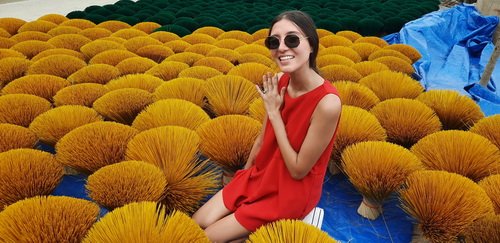
When the sun is strong, local families can spread the dyed bamboo sticks outdoors to dry. This is when Quang Phu Cau is at its most colorful.
On cloudy or rainy days, much of the production may take place indoors or the drying areas may contain fewer incense sticks.
For photography, morning visits are generally a good choice, especially when combined with suitable weather and active production.
The period leading up to Tet, the Vietnamese Lunar New Year, can be particularly interesting because incense demand traditionally increases and the village becomes busier with production.
However, there is no single day when the village looks exactly the same.
That is part of the experience.
Incense and Vietnamese Culture
To understand Quang Phu Cau, it helps to understand why incense is important in Vietnam.
Incense is closely connected to Vietnamese family traditions, religious practices and ancestor worship.
In many Vietnamese homes, a small altar is a place where family members remember parents, grandparents and earlier generations. Incense is traditionally burned during important occasions, festivals and family ceremonies.
For many Vietnamese people, the fragrance of incense is therefore associated with memory, respect and connection with ancestors.
A stick of incense may look simple, but it carries a meaning that goes far beyond its physical form.
This is one reason local artisans take their work seriously.
As one Hanoi cultural source explains, incense production in Quang Phu Cau is regarded not simply as a livelihood but as a craft connected to Vietnamese spiritual and cultural life.
Quang Phu Cau Beyond the Photographs
The colorful incense is undoubtedly the main attraction.
But if you only stop for ten minutes, take a few photographs and leave, you will miss much of what makes the village interesting.
Take some time to watch the workers.
Notice how quickly they handle the bamboo sticks.
Look at the different colors and textures.
Walk through the smaller lanes.
Listen to the sound of bamboo being processed.
And, if the opportunity is available, talk with the local people.
You begin to realize that Quang Phu Cau is not really about the red incense sticks.
It is about the people who make them.
Generations of local knowledge have gone into understanding the materials, preparing the incense and maintaining the quality of the final product.
The photographs may be what brings travelers here, but the human stories are what make the destination memorable.
A Living Craft Village, Not a Museum
One of the things I like most about taking visitors to Quang Phu Cau is that nothing feels completely frozen in the past.
There are traditional methods, but there are also modern machines.
There are old family workshops, but there are also larger-scale production facilities.
There are quiet village lanes, but there are also busy working areas.
This mixture of tradition and modern life is typical of many Vietnamese craft villages.
Quang Phu Cau has not survived by refusing to change.
It has survived because local people have found ways to adapt the craft to modern demand while keeping its identity.
That makes it an interesting destination not only for photographers, but also for travelers who want to understand how traditional Vietnamese industries continue to function today.
What Can You Experience at Quang Phu Cau?
A visit to Quang Phu Cau can be as simple or as detailed as you want it to be.
You can:
- Walk through the traditional craft village
- See bamboo incense sticks being prepared
- Watch workers dye and bundle the sticks
- Learn how incense is produced
- Visit working family workshops
- Photograph the colorful incense-drying areas
- Meet local artisans
- Learn about the role of incense in Vietnamese culture
- Experience rural life outside central Hanoi
- Buy locally made incense products, if you wish
For photographers, the village offers countless compositions.
For culture lovers, it provides a glimpse into a traditional craft.
And for travelers who have already explored Hanoi’s major attractions, it offers something completely different.
Is Quang Phu Cau Worth Visiting?
I would say yes — especially if you are looking for something beyond Hanoi’s standard sightseeing route.
If this is your first visit to Hanoi and you only have a few hours, I would still recommend seeing the city’s historic landmarks first.
But if you have already visited the Old Quarter, Hoan Kiem Lake, the Temple of Literature or the Ho Chi Minh Complex — or simply want to see another side of northern Vietnam — Quang Phu Cau makes an excellent half-day experience.
The journey takes you away from the city and into a working rural community without requiring a full-day trip.
And unlike a conventional attraction, the experience changes according to the season, weather and daily production.
Every visit can be slightly different.
Quang Phu Cau as a Destination from Hanoi
Today, Quang Phu Cau has become one of the most distinctive cultural destinations on the outskirts of Hanoi.
Its popularity has grown partly because of social media and photography, but the destination has a much deeper story.
It represents a part of the traditional rural economy of northern Vietnam.
It shows how a craft can survive for more than a century.
It demonstrates how local families can combine traditional knowledge with modern production.
And it provides visitors with an opportunity to see a side of Hanoi that is very different from the city’s famous monuments and busy tourist streets.
Most importantly, Quang Phu Cau is still a living village.
People live here.
People work here.
Children grow up here.
And incense continues to be produced here for Vietnamese families and communities.
That is what gives the destination its character.
Visiting Quang Phu Cau with a Local Guide
If you visit Quang Phu Cau independently, you can certainly enjoy the colorful scenery.
But having a local guide can make the experience more meaningful.
A guide can explain the production process, introduce you to local artisans, help with communication and show you different parts of the village rather than simply taking you to the most photographed spot.
For me, the goal is not just to show visitors where to take a good photograph.
It is to help them understand what they are looking at.
When you leave Quang Phu Cau, I hope you remember more than the red incense bundles.
I hope you remember the people, the fragrance in the air, the sound of bamboo being processed, the quiet village lanes and the story of a traditional craft that has remained part of Vietnamese life for more than a century.
That is the real Quang Phu Cau.